Tuesday, December 18, 2012

Waydown #12.12.18

Well, more like four months but that's not as bad as it could be.

So this blog-zine thing hasn't set the world on fire.  Even in the Pulp Legacy world it hasn't gone far.  I have no idea if anybody has even read any of these posts.  One APAer said it was a pretty good idea and might post their own zine.  But whether for more zines or for posting feedback, this blog has seen no more activity since I'm posting these zines than before.  Which is fine.  I didn't expect this to go far.  As usual I'm writing for myself, and while I'm getting this out, the fact that this is more accessible doesn't guarantee more interest.  But it's there if you want it.  I'll keep posting this because I must write.


Within the time that I was editing this, I got a new phone. I got a Samsung Galaxy S3, to replace my HTC Evo. This isn't as significant an event as when I first got a smartphone, since that was a life-changer and this is just a life-continuer. I loved my Evo but I needed a new phone. The worst problem was the battery, which had gotten ridiculous: I would let it charge overnight then in the morning, with only my GPS on for the Nav unit on my way to work, it would say I had a 15% charge within 45 minutes, then it would be dead about 5 minutes later. And I know the hardware was outdated, and I knew there was stuff that newer phones could do that I was interested in, so it was time that I gave it up. I was holding out for a sale, almost went to Best Buy on Black Friday to get a crazy deal, and I came close a time or two but eventually got one on Amazon at the price I wanted, and re-upped my contract with Sprint for another two years which I was happy to do since I like them. The phone came basically six weeks early (as Amazon initially said they were out of stock on it) and two days after ordering I had it up and running. I'm still figuring out the new functions but so far it's a significant improvement, though with enough familiar stuff that I can get going with it. I heard the Samsung GS3 was better than an iPhone (as if I'd get an iPhone in the first place) and it hasn't disappointed. Probably won't be long until I'm doing what I do here on a computer on the phone instead (I mean, more).

I get up at 6 every morning for work, 8 on weekends but not often much later than that.  That first hour after getting up is torture, and I have great sympathy for anyone who has to deal with me at that time, but I’ve found getting up that early and into the day, I get a lot done and am just more productive before lunch.  I fear I’ve somehow I’ve become... a morning person.  It’s always seemed against my nature but most of the rest of my family are morning people so it might make sense that I eventually would be as well.  It probably helps that things can be a lot easier when I get up that early (fitting in with Carla’s schedule, dealing with traffic, getting to work on time (-ish), etc.) and that I don’t stay up as late at night as I used to (with the intention of getting at least six hours of sleep).  I never thought I would ever be someone who enjoyed the morning.  Then again, I never thought I’d have to get up at 6 every day.  But that’s my limit.  There’s such a thing as too much of a morning.

I've been thinking of maybe giving each of my new zines a theme.  Maybe writing a bit about or in the context of a particular interest or phase in my life, though keeping the Reviews and Raves section the same, since those are my stand-bys and maybe even help define this project as I've done it.  For the time being I'll just have the usual stuff and whatever else I think to drop in.

Great writing advice: http://daadams.com/2012/12/13/creative-writing-ramblings/
(Yes, read it.)


REVIEWS

Steve Jobs by Walter Isaacson (audiobook).  I wouldn't have imagined that I would have had any interest in the Steve Jobs biography but Carla was borrowing the audiobook CDs and I was putting them on the computer anyway and I didn’t have any other book lined up to listen to so I thought I would give it a spin.  Jobs as a celebrity wasn't always much to talk about and he wasn't much of a visionary because I don’t care for Apple as a company (I love the iPods but the rest can burn).  I admit, there was a lot more to him than I thought.  I didn’t have the historical perspective on him or his achievements because I never bothered to look up any information on him. There was a lot to learn.  His life story is not all that interesting -- sure, he grew up a genius but a lot of the things in his early life were pretty predictable: a rebellious spirit that caused him some great problems throughout his life but also led him to changing the world with Apple and his other various endeavors.  I didn’t realize it but he really did change the world.  He also had a tendency to be an asshole, which kept people, even his closest creative partners and business associates, at a distance, but it was also how he was able to see his visions through.  There aren’t a lot of deep details but the writer paints in broad strokes so you get a good view of the man as a man, as balanced as might be possible, which might not be notable except that the book does not actually try to play up how great he was at every turn.  There are some parts, with testimonies by his confidants, that attest to how much of a jerk he could be.  But parts of how much good he did as well.  The book does not get a real emotional center until near the end when Jobs discovered he had cancer through the rest of his life until he succumbed to it.  There are always two ways that these kinds of books end: the subject overcomes the difficulties and rises as a hero, and the events of their life are transcribed from the positive perspective of someone who not only survived but triumphed; or they die.  Autobiographies often seem to be the former, biographies seem to be the latter.  So the book, ending with Jobs’ death, is as definitive as it’s likely to be.  And also leaves you in a post-Apple world, knowing that the kinds of innovations and marvels that the man brought about may not be seen again in your lifetime.  It’s a testament to writing when a book can show you how great a man is, instead of just telling you, and you believe it.  I have no more interest in buying an iPad any more than I did before, but I can respect where it came from much better than I did.

The book is read by Dylan Baker, an actor you'd recognize from a lot of movies but mostly as Doc Connor from the Sam Raimi Spider-Man movies. That they would use such a recognizable actor shows that the adaptation of this book is intended as the highest class, as it is. The reading is very measured and Baker doesn't put a spin on voices. There's not a lot of personality in the voice but it doesn't really need it, and maybe it mirrors Jobs' often lack of real emotion in many of his interpersonal dealings. It's over nine discs, which took me about two weeks to get through, which seems to be my going rate.


Pattern Recognition by William Gibson (audiobook).  Yet another William Gibson book, and I really was not expecting much. This is the first book in the series that includes Spook Country, the first audiobook I ever listened to and a story I did not care for, so I didn't have high hopes for this one.  What a surprise then that I actually enjoyed it. I don't want to say that my enjoyment of the book had only to do with my expectations and how they were exceeded, but that maybe it actually is a good book.  The book focuses on one character instead of three; his best and worst books seem to center on more than one character, and this was great when it was good because it was more characters to explore the world he was creating (mostly in his cyberpunk books) and it was still pretty good when the books were bad since there was an alternative to the worst parts.  In this book he is able to mold the world, a modern-day one, around that one main character and it fits much better without the ambition of trying to fill in the world and going too far.  There are explosions of current-time companies and products but it’s a function that involves the main character, so it’s not an unwieldy attempt to be timely and -- ug -- hip, like in Spook Country, but rather one that defines her and places the story in a certain time and context, setting it rather than trying to keep up with it.  The book has more inspiration than Gibson has shown since his original cyberpunk trilogy.  If I read this book first I would think that it was a return to form and I’d be excited about the books that came after it in the series but I’ve already gone through the next in the series and am sad that it doesn’t carry the same inspiration. Zero History, the the third book in that series, is the next book I'm going to get to so I'll use that as a tie-breaker. Formed only around my love for Neuromancer and the Sprawl Trilogy, I’ll give the man the benefit of a doubt, though it goes against my best judgment.  Hope is so modern-day but that’s not always a curse.
The audiobook is narrated by Shelly Frasier and she’s probably my favorite narrator of all the audiobooks I’ve listened to to this point.  Her tone is almost eerily consistent and a touch frigid, which actually suits the material well.  She gives distinct voices  to the character but they’re never irritating and usually only just enough to make it so you can differentiate between the characters.  It’s an easy tone that carries through the book rather than pushes.  I enjoyed her voice so much that I’d be tempted to get more audiobooks she’s read just because they’d be so easy to listen to.


See A Little Light: The Trail of Rage and Melody by Bob Mould (audiobook).  My entry into Bob Mould's work was through Sugar, in the mid-'90s.  It was a blast of pop hooks and guitar shreds, both of which have always been my thing.  I wasn't the biggest Mould fan in the world then, since his solo work didn't have as much of the things I loved about his music and it was still years before I discovered Husker Du and Beaster.  The significant thing about being a fan of his was discovering his personal life and, in what I thought was a simple puff piece in Rolling Stone, finding out he was gay.  At the time, early in college, I didn't know any out-people and I didn't know anything about the lifestyle.  This didn't turn me off of his music but it did make me reconsider, trying to fit it into some context of being about a homosexual relationship.  But I'm a big believer that you find your own truth in art and I didn't necessarily make his music, to me, about his being gay.  It was still great music, I still listen to it.  But I didn't think his life was much more beyond being a respected, veteran songwriter and performer and that there was no need to investigate further. But I got the book (twice, as a gift, because people know me; then later got the audiobook because I knew I wouldn't be able to read it any time soon) because I thought that there must be something else there, in the history and the personality, worth filling a book.

It shouldn't be necessary to dig into an artist's life for any further investigation into what they mean in the music they creates.  But Mould wrote an autobiography anyway.  Call it cashing in on the rock-star bio craze -- he probably hasn't made a mountain of cash with his music and if he gets some kind of success with a book then he deserves it, with all the work he put into the life he reveals in the words.  It's not really an extraordinary tale -- he was a rock star who didn't take over the world but got a lot of respect and has had a long, fruitful career, one which is still going.  Deep secrets are the rock bio's stock in trade but there aren't many here, at least not that would be scandalous or world-beating.  It's the story of a man's life told well but it's not always riveting reading.  The biggest catch, and the worst thing about the book, is Mould starting a story with great potential but ending it before it gets to anything really interesting (if there was anything really interesting that happened in the story in the first place).  But the book isn't just for big fans of Mould and his work: he's still a man who grew up in the Mid-West and since his music never overtook every corner of the world, some of it is still unknown to all but the deepest fans who have been following him for years.  (At the time of my going through the book, I didn't have either of his first two solo albums, of which he goes deeply into the creation.)  The center of Mould's story, predictably, is his life as a gay man, less that he decided he was gay and how he came out to the world but how he came to live with that side of himself and how he eventually became comfortable with his sexuality (enough to write a book about it).  It's not just a coming-out tale that many gay people could relate to but also for any person uncomfortable with their lives and experiences and self, which is a lot of the people who found something in his music in the first place.  There are also stories of becoming internationally reknowned as an aritst with Husker Du and also some pop success with Sugar, as well as going into the making of and touring for Beaster (an album that has come to mean a lot to me personally), and how everything after that was a bit of a disappointment commercially, especially a few electronica-leaning projects, but Mould defends how he was following his muse while admitting that he had a few missteps.  The auto-bio is about taking stock while looking back, after all.  So there are a number of things to find, for a broad audience.  It doesn't go very deep but it's honest.  And hopefully it's not a story that is fully written, as Mould continues to live and to keep seeking the fullest experession of that life.  You couldn't ask for more in an autobiography.
The recording sounds really tinny, like it was recorded in a kitchen near lots of shiny, metal appliances. A lot different from the slick productions I've heard to this point. Mould isn't a natural or gifted orator – nearly every sentence ends with a heavy, exasperated sigh, though it sounds genuine and there actually is a flow to it. After listening to the same voice for about 10 hours it's a bit jarring to hear a snippet of music at the end and Mould's singing/yelling voice but it's welcome. I don't know why these audiobooks on rock stars don't have more music in them (unless it's a bullshit legal thing). It's about 10 hours. I got through it in about a week and a half.


Modern Masters Volume 12: Michael Golden (TwoMorrows Publishing).  I'm a fan of anything that TwoMorrows puts out, from Back Issue and Write! to even The Jack Kirby Collector.  They're a class act, putting out scores of publications about comics and creators, and their output of comics-related material could rarely be beat.  They don't overanalyze or deeply criticize if they don't need to, and their interest is far-ranging.  The series of books (which now number a few dozen volumes) on artists are a no-brainer for any comics fan.  They're beautiful books, oversized to show art bigger than a comics format, and a big stack of pages.  It was inevitable that I would get the volume on Michael Golden (or, um, borrow it).  It's packed with many of his pages and lots of art, including original versions of pages and convention sketches that have never before been published.  Running alongside the art is an interview with Golden, though it's more like a rambling conversation.  There's a wealth of material but it's a shame that it's all so scatter-shot.  The art seems like they are random pages picked willy-nilly, most of it great, but not all of his greatest stuff and even a few lackluster pieces here and there that seem out of place.  This is, of course, the problem with these kinds of books, that they can only show so many pieces and it comes out as an overview of an artist's work, hitting some high points but aiming more toward getting a broad look at the body of work in general.  The interview is much the same way, spread over an entire career but frustratingly never going into detail (Avengers Annual #10 only gets half a page?).  It's probably the case that many artists don't have much to say and may not make for a great interview, but Golden was also an editor for DC (a fact that had slipped by me) and even presents himself first and foremost as a storyteller, including being a writer, so he could certainly keep a conversation going with more depth than we get.  But this isn't The Comics Journal.  The book is more focused on the art, as it should be (the interview runs out about three-quarters of the way through, leading into a gallery of mish-mashed pieces, all brilliant).  The words are to give it continuity and keep it going, showing another side of the artist.  I would ask for a deeper interview (which would work here but wouldn't with every artist profiled in the series) but that would pull it away from its original mission.  That they have so many gorgeous, extraordinary pieces packed into the pages, that it isn't a complete showing is only a minor quibble.  Though now that I think about it: as much as I love books and printed pages, one day when this kind of project is available online so as to include a real gallery with a complete catalog of art will be an extraordinary thing.  For now, this is good.  There are plenty more books to get to in this series, spotlighting a broad range of popular, usually iconic artists, all unique in their own fashion.


Almighty (self-published).  I picked this up at House of Secrets.  It was given a high profile (displayed on an endcap facing the front door), giving the impression that it deserved to be looked at (though not realizing that the recognition was given more because the shop's owners were including the creator in a project later on).  It's a book smaller in format than a regular comic, which usually irritates comics readers but I find it endearing and I'm more drawn to (or at least not drawn away from) books in an irregular size (since I'm not organizing it as part of a collection).  It even seems to play some kind of psychological trick, the smaller size and closer panels bringing an immediacy to it, maybe even the fact that it's nearer to a paperback novel lending it some kind of pulp feel.  Anyway, the pages looked nice when I paged through them and it was only ten bucks so I went for it.  If nothing else, I was supporting a local artist. The art is, indeed, good.  Probably not up to mass-market standards, and a few rough panels make it clear the guy, Ed Laroche, is just starting out, but if this book doesn't hit all the buttons it should, it shows potential.  It reads like the first few volumes of Y the Last Man, but that could be to me only because I was reading that series recently and/or because the escapee-helped-to-safety-by-the-tough-mercenary-chick troupe is popular nowadays.  That it's a dreary post-apocolayptic yarn doesn't help, especially when that apocalypse is never explained, and even annoyingly when this world dozens of years in the future looks like just like the present day.  Basically Laroche couldn't think of a better place to set a story where he would have free reign than in a poorly-designated period of some future.  The story is barely a sketch, and it's certainly not anything new, but Laroche believes in it enough to keep the art going to support it.  That the art is often a sketch works in its favor and it's appealing, even more because it works better in black & white.  Put this guy with a good writer and they could make dynamite.  Even keep it in black & white, retain the tough chicks, and leave it in that bland post-apocalypse -- just give the art some kind of purpose.  And keep the size of the book.


Recently I finished the audiobook for Monkey Mind by Daniel Smith. I've been holding off on listening to more audiobooks since I'm behind on writing reviews to what I've already listened to and I've started getting into podcasts and there's only so much time in the day. The only progress on stuff I'm reading is that I have Iron Man: Extremis on the nightstand and it's ridiculous that it's taking any longer than, say, than two sittings to get through but there's only so much I can give it.


Avengers Alliance. I never thought I would play a Facebook game but it took a Marvel comics game, right before the Avengers movie hit, to get me to do it.  I started on it, back in March, just out of curiosity.  How great could it be?  Besides, it was free and I was unemployed at the time and there wasn't any reason not to.  Right away I was struck by how accurate it is regarding the Marvel Universe.  I don’t think it was created by Marvel but they either had some say in it or the creator is a big Marvel fan.  It’s so basic and simple it wouldn’t be much fun on its own but you control the Marvel heroes, picking characters for your team and taking them on missions, and if you love those characters, it can be a blast.  In the game you’re a S.H.I.E.L.D. agent -- that’s not quite as much fun but it makes sense; you control the characters just the same and you’re free to develop your avatar on your own, so it’s maybe ideal.  You also ally with Facebook friends and give each other equipment and supplies as gifts, so there’s a social component, and a reward for getting your friends to play it.

I haven’t been able to play it as much since I’ve been working (though when I do play it's usually at work) but I still check in every day, receive and send gifts, and send my team of Avengers on mini-missions that you don’t actually play but they get rewards for being out of action for a while.  Half my co-workers are playing it too (a lot more than me) so that’s our at-work conversations most days.  The game is simple enough that it can be appealing to nearly anyone, though there’s a combat component to it that might not do much for anyone who doesn’t care for fighting games (which is usually me but, again, it's the Avengers).  But you fight villains from all over Marvel comics, some as obscure as you could ask for.  There are also a lot of characters that feature in stories that hold the missions together so you’re really immersed in the universe.  For anyone who doesn’t want to play an actual video game, it’s about as close to being in Marvel Universe as you can get.

Right now my agent is level 32 (some of my friends are well over 100 already).  On my team I have Iron Man, Hawkeye, and Black Widow (which you start with); She-Hulk, who I picked from a few that it gave for free early on; Iron Fist and Ms. Marvel, who I spent Command Points to get; and Captain America, who I got only recently (and that took an embarrassingly long time. How can anyone play an Avengers game without Captain America?).  For an Avengers game, there’s actually not a huge selection of actual Avengers that you can recruit.  Scarlet Witch and Quicksilver are about as obscure as you can get.  There are probably more X-Men than Avengers to choose from.  And of course Spider-Man and Wolverine are included in there (I might not ever consider them real Avengers but there's a younger generation playing this game and those are Avengers as much as anyone).  So, that it’s an Avengers team is about as loosely termed as you can get but considering just about any hero is an Avengers these days in the comics, it’s fairly accurate.  Of course I’m a loyalist so I only pick Avengers.  (I wouldn’t have considered Iron Fist an Avenger for this but I needed a cheap Scrapper on my team.)

There’s a PVP mode where you can play other players.  This doesn’t do much for me but I checked it out to earn some XP for doing it. You don't actually really play against another player; you set up your team and it plays for you while you're away so you can earn tournament points (which can be used to get rewards, including unlocking new heroes) even while you're away, if your heroes are good enough. (That this was automated took me until very recently to realize.) My one point of contention with the game is that if you lose to someone in PVP, you have an option to get revenge and play them again.  Real heroes do not seek revenge.

There are already a few people from the APA and who might be reading this who are already on the game.  And if they're not, why not?  It’s free, you can play as casually as you want, and it’s a bit of fun.  It gets to be more fun the more you stick with it.  I’m surprised that more of my comics-loving friends aren’t on it.


(The Intended) Best Of 2010:

There was a problem with the Kanye West track and the plan was to edit it, which would have made room for at least one more track, but one copy, listened to once, was as far as it went. There didn't seem much point to make more. No one has asked about it.
Extras/Additional Alternatives:
Barely gave any thought about a 2011 one. But if challenged I could come up with a track-listing.


Something I wrote for an e-mail circle that ended up being an essay (and I didn't include you in that circle since you could read it here but if you want, I could jump you in to the conversation):


A while ago we were talking about the so-called “greatest” music of the ‘80s and ‘90s.  Boring started the conversation, I don’t think he ever said why.  And it’s given me something to ponder in the time since.

I originally asked Tom if he wanted to know what we thought was the greatest music of those eras or what our favorites of that era were.  Those can be two totally different things.  Then there's what was the most popular music of that time, which is also a different thing but could be considered by some to be deserving of being called "the greatest" (and which anyone can find by doing some research on the pop charts).  I still don’t know what project he was working on that he needed our opinions, though if he told us from the beginning it could have helped us help him.

What makes music more great, if it’s popular or if you love it?  I could give you a list of albums that I plan to be listening to on my deathbed but there's stuff that no one else in the world seems to ever have heard besides me.  And there’s plenty of music beloved by everyone else in the world that doesn’t do a thing for me.  Nothing wrong with either one.  But if you ask someone what a great album is, there needs to be a qualifier for how they come to call it that.

A good number of people will say that Sgt. Pepper’s Lonely Hearts Club Band is the greatest album ever made but I wouldn’t personally agree.  It’s not even my favorite Beatles album.  But no one has ever heard of the Meices except me.  Yeah, Doolittle and Appetite for Destruction and Substance are on my all-time list (not just for ‘80s and ‘90s albums but overall) but a lot of people would put a lot of music ahead of that.  I’ve never been a Beach Boys or Zepplin fan and it’s only the last few years that I’ve began to acquaint myself with Pink Floyd.  It could be a matter of personal taste... if that’s what you’re asking for.

Add another level to it and question the context of the era.  There are some albums that might be great overall but not great for the era, or vice-versa.  A lot of the best albums are timeless and could fit in any other era.  Imagine Nevermind in the late-‘70s with the early punks or Aenima amidst the formative prog-rock or Is This It in the early-‘90s with the alt-rock period or Paul’s Boutique around 2000.  OK Computer could almost be a better album in any other era except the ‘90s. If those albums had hit in difference decades, we would be living in a different world.  Most that were best for a certain era are forgotten now (like every rap-rock album except for anything by Rage Against The Machine).  And so much of the second half of the ‘80s and the early half of the ‘90s blend together anyway, especially since the seismic shift that came with Nirvana and grunge guiding alternative music and culture into the mainstream right in the middle of the transitions of those periods in time.  For someone who just really loves music, the time period it comes from is usually of very little consequence except for a historical context, which is completely unnecessary to just enjoy a song.

Also the matter of how that music has aged.  Stuff that sounded so great back can sound so worn now. What was so great back then might not be as great now; what might have been only hanging around at the time might have a greater significance later on.  There was a lot of angry music in the ‘90s that I related to more than anything but now it sounds almost silly.  I’ve come to appreciate the softer or poppier sides of Nine Inch Nails more in the time since I took so much comfort in those blasts of anger.  The rage in that music is still genuine and effective but now it seems so overdone and, since so often I felt that it only changed me, ineffectual.  There was probably a time when the Chili Peppers really fit with what was happening in pop music but now it’s best for the components of the songs rather than the songs themselves (and certainly not the lyrics). I keep rediscovering the Replacements, for as much as I started listening to them back, I'm listening to them now more than ever. So much music that went overlooked back when it should have changed the world might now have a new peak as it ingratiates itself into history and new audiences discover it.

Consider what age you were back then too.  I feel lucky now that I had such great music that my teenaged and college-age angst could connect to back in the early ‘90s.  Much better than if I’d been that age just half a dozen years later and tried to relate to rap-rock.  I would probably be a completely different person if I hadn’t had that music back then.  And I still hold a lot of that music dear to my heart, even if I’ve grown to realize that as music it wasn’t great.  You go through phases in your life and what you enjoy can wax and wane: you may not get as much out of angry music now as you did when you were young and angry, and there may be some music that you just don’t have the ability to appreciate quite yet.  I’m still waiting for my tastes to develop far enough so I can fully understand and enjoy jazz.  There are a number of factors that come into play in determining how much you enjoy certain music, sometimes beyond just a matter of taste, but that list, if I could even compile it, would probably be longer than I have space for here.

I’ve heard that the music that you’re listening to when you’re 25 is what you’ll probably listen to the rest of your life.  I was listening to a lot of my usual stuff, a lot of alt-rock but some from pop radio, but digging deeper into it, as well as exploring some stuff from even before my own life started, then always an aggressive appetite for new stuff, and that’s how I’ve been in the time since so I’d say that probably holds up.  A person listening to a narrow range of music at that time, no matter how passionate about it, probably isn’t a serious, life-long music-listener in the first place so it probably holds up for them too.  Music is different things for different people at different times and that’s a great part of its beauty.

But really, it’s so subjective anyway that posing the question of what a person thinks is the greatest music of any era, for a serious discussion, opens the floodgates way too wide.  So, again: this would have been a lot easier if Boring had just told us specifically what he wanted and what he wanted it for in the first place. Or he could send us his own list so we could make fun of it.

And don’t even get me started on singles vs. albums.  That might be an even lengthier e-mail.


RAVES


White wine. I’ve never been much a wine drinker, especially not white wine, but I’ve found that it goes well with dinner.  Early on we would switch between red and white but eventually started going with white, to make the decision easy and since white seemed to go with a lot more than red would.  Now we drink white even with, say, beef.  We would have red on occasion, say, with pizza, but even that we ditched since, especially on weeknights, we’d be groggy the next day from it, if not outright hung over (well, me, really. I'm a lightweight sometimes anymore).  Now, we might keep a bottle of red around just in case but usually it's usually for special occasions (namely weekends).  We never spend extravagantly on wine, and we’ve found a number of white wines under $10 that we like.  (One tip I knew about wine before I ever started drinking it is that expensive wine isn’t necessarily always better than cheaper stuff.)  We pick from a wide variety from different stores and we seem to have a different bottle every night, mostly because we usually don’t remember which we’ve had that we really liked.  It’s generally a pinot griogio and sometimes a sauvagnon blanc so that’s about as far as my knowledge about white wine goes these days.  It’s a lot lighter than beer and I like venturing into the wide world of wine.  I also know my limits with wine, and even the both of us finishing off a bottle probably won’t wreck us (well, me) the next day.  I probably won’t go farther than this but for one or two nights a week and special dinners, it’s great.

Interval training.  25 minutes of an easy run as warm-up; one minute (or two blocks) of running as hard as hard running; one minute of walking (not jogging); repeat eight to 12 times; increase two blocks of hard running to three blocks toward end of run (optional); 25 minutes of easy run as cool-down; walk the rest of the way home.

Peanut butter-filled pretzels.  Zara recommended these and they're brilliant.  I'm actually not a huge pretzel fan and I'm not always particularly into peanut butter but you put these two together and they're magic.  Needless to say, the ones from Fresh & Easy are the best.  But beware: Combos -- which are cheese-filled pretzels -- are fucking rank.

Using one paper towel instead of two.  When I remember. I'm getting better about it.


I have never spent more time editing anything than I spent editing this.

For some reason the pictures in this were easy to insert this time. I didn't do anything to change the pictures, just put them in here and for a few made them bigger. I guess HTML can be agreeable when you stick to the defaults (which I would do if it would work correctly more consistently). Made this a lot less of a pain to put together (though still seemed to take forever). Though going back and re-editing everything after the version it published was different than what it said it would post was a pain but that shouldn't be surprising. HTML can suck my ass.


Next time I'll probably talk about the Marvel Heroic Roleplaying Game and I have five more audiobooks to review so I should be able to fill up some more space. Maybe someone will read this stuff.


Thursday, August 9, 2012

Waydown #12.08.09

Well, a little over three months, then.  About the frequency of the print version of the APA, so this is about fair. Not that I’ve planned it this way, and I really have tried to stay with posting one of these with some kind of respectable frequency, but I went through a lot of material and it soon outstripped what I had time to write about.  There’s no one holding me to a deadline so it got out of hand, as it usually does with me when I don't have a fire under me.

A big update is that I took my music from part-digital/part-CD to all-digital.  (There are number of music fans in this circle and a lot of that I’ve traded CDs with so this could be a relevant topic.)  It's been a  while that I've thought about changing my music-rotation system and I finally had a trigger to get it done.  For the last few years I've run everything I listen to through my iPods -- switching music in and out every morning, rotating fresh stuff so I don't listen to the same stuff over and over.  (Using the iPods was mostly so I didn't have to lug a case of CDs to work with me every day, like I used to.)  It's a process but it's made a lot easier since I ripped all of my CDs into my computer gradually over the last few years.  I still kept the CDs but really only for listening while at home.  Increasingly I've downloaded more albums than I've bought on CD, and I'd have to burn a CD just to listen to an album at home, if I even wanted to listen to music on the (increasingly more antiquated-looking) stereo and not on my computer or on Pandora.  While it became easier to put music directly on my listening device(s), CDs started to be a bit of pain.  But that's what I've done for music since I got a CD player (in 1992).  And left to my own devices, I'm going to keep digging furrows into the same paths day after day.  Really, the CDs were just place-markers so I could organize the music in rotation.  So Carla moving in* became the push to get the CDs out of the apartment.  We cleared out a lot of the space and we're not living with as much clutter.  But certainly I didn't get rid of the CDs, I just boxed them all up and they're in storage.  I have my whole music-rotation all in the computer and it's worked fine -- still some advantages to the CDs but overall all-digital is more efficient.  But if I've gotten along fine without the CDs, I don't know if I see a reason to ever bring them back.  The technology will only improve and it will only get easier and more efficient when the new stuff comes out.  And I personally don't hear a difference in quality between CD and MP3 that moves me in any way.  (I know there's a difference between vinyl and MP3 but I only have one vinyl album and it's not even music.)  It's a buyer's market for CDs right now so it might get to be too late to get a decent price for selling CDs (if it isn't already) but I can't give them up.  So the CDs sit in storage.  But I still have a bunch of CDs that were burns or copies of stuff I have in the computer, stuff I can't sell, so someone might be coming into a wealth of CD-Rs before too long, maybe someone around here.
(* Oh, yeah, that's big news too.)

The biggest update for me, at least for the last month, is my change in e-mail address.  I use my e-mail a lot and it's how I usually best keep in touch with my people so a change in it is a real big deal.  I've had my AOL address for nearly 16 years and I always thought I would have it forever.  It still serves me well but I can do better.  Gmail seems like a lot more efficient means of e-mail; put the two side-by-side and Gmail just destroys AOL (even if you use the new version of the latter, which I don't always do).  And there's no sense in continuing to pay for AOL -- yes, I pay for AOL.  Even if it wasn't just that, a change is good sometimes.  I've also got a Hotmail account that is just for mailing lists, no personal stuff, and I should have done that years ago.  I was planning to include an update of how many e-mails I’m behind, like I used to for my print-zine, just for everyone’s amusement, but I’m no longer keeping track.  I’m going through that old AOL e-mail and I still intend to reply to all of it, I’ve just changed the process of how I’m doing it and I won't organize it like I used to (probably a good thing, to have one less thing to contribute to my OCD).  So I'll have the AOL address for a little while longer until I transfer everything over.  And switching stuff (mostly mailing lists) might take a while because it's a real pain to do.  I've never done it before, I've just always had everything go through AOL.  But no longer.  There are new territories to explore.  This is the first, maybe biggest, step, in a long journey.  I have a lot of e-mails to catch up on.

It’s been a good summer.  I haven’t done a lot of summer-specific things, except trying to keep the apartment cooler than usual, and if it wasn’t for the San Diego comic con I might not have even noticed it was the summer.  When I’m not working in the summer I can take more advantage of the season but since I’ve been so busy it could be almost any time of the year (since you don’t get a lot of substantial change in the weather in California).  But it’s better that I’m working in the summer.  More time to get things like this zine/blog entry done.


REVIEWS

On Writing by Stephen King (audiobook).  I haven’t read any more of King's work than some short stories he had in Esquire since I blew through The Green Mile in ‘99.  I just drifted away from his books and, though I owned (and subsequently got rid of) a lot of his stuff, reading most of it in high school, I didn’t think I’d go back to reading much of it.  Though his On Writing was something different and, while I wasn’t really planning on reading any of his fiction, I respected him enough as a writer that I wanted to read his thoughts on the process of writing.  I’m pretty sure I got the book a few Christmases ago but it’s been sitting on a shelf since, along with other books on writing that I plan to read... eventually.  eMusic had that book and I needed a new one to read (er, listen to) and this was my non-fiction book, after doing a fiction one.

I’ve read a lot of books on writing along with countless articles but there was advice in King's book that was new to me and it may fundamentally change my writing (as well as maybe getting me to write again... eventually).  I don’t know how much it may appeal to his fans who aren’t writers, though it may appeal to writers who aren’t fans, but it really spoke to me (um, literally, I reckon).  There was a goodly-sized section about how he structures his stories, about making them all a “what if?” scenario then running with it from there.  I never really thought about setting up a story like that but it made sense to me and I've compared stories that I've read to that in the time since reading it.  Also some mechanics about grammar that really place the book as being one about writing, though it's more a few things in reading that really irk him and he uses the book as a forum to get these pet peeves off his chest.

King declares that he will never write an autobiography.  He's fully aware that his life-story is nothing extraordinary and even telling of the rise of his success would be a short read.  But he's also been begged over the years, both by his fans and his editors, to write a book on writing so he splits the difference.  The autobiography part, about the first third of the book, is actually just to give some background to the parts of his lectures in the rest of the book. King has never been accused of skimping on words in his writing but it usually works, especially here.  Once he sets it up, he can go to a lot of corners.  But the autobiography really does shine a light on his early life, one that he might not realize he's opening up as much as he does.  As an autobiography, albeit an abbreviated one, it works well.  The story of when he sold Carrie is particularly affecting.  Then the book takes a turn near the end, going chronologically (unusual for a book on writing), when he details nearly getting killed when a van hit him.  There are clearly some issues he has about the incident and it impacted his writing, even so far as almost leading him to retirement.  That really doesn't contribute to the discussion about writing but it's interesting to see, early in the book and in his life and then later in both, that his life experiences so informed and changed his writing, life, and writing life.  The lessons he shares and the insight into his writing and life is the meat of the book.  Any advice from a successful artist, even if you don't care for their creations, is worth paying attention to, and for someone of King's caliber, maybe the top of all popular writers of the last 35 years, is worth its weight in gold, if you have any interest in it.  And it certainly is gold.  It's a different kind of writing but it's just as powerful as King's fiction. It's a shame he won't do more – he says it took a lot for him to do even one book – but that he did one is as satisfying as anyone could hope it could be.

King reads the book himself.   I realized as I started it that I don't think I've ever heard King speak -- it's probably a good thing he doesn't do more kinds of stuff like that because he has a pretty geeky voice.  He seems to want to distance himself from the book, that he only wrote the thing because so many people pestered him about it and he felt a sense of obligation to do it, but that he took the time to read the book aloud for recording shows that he has some personal connection to it.  To read such a personal piece of work, it's good to not have someone who doesn't have a personal stake in it do it.   He's very level in his reading, never going into a flight of fancy, and his voice is clear.  That he's connected to it probably brings a warmth to it as well.  The thing was about 10 tracks (about an hour and a half each) and I got through it in less than two weeks, but I was pacing myself.

I loved it so much, it may even get me back to reading King's stuff, especially if I can just download his catalog from eMusic.  I never got to The Dead Zone or most of anything past Dolores Claiborne (and after that one, can you blame me?).  Then right after I wrote this I saw that he’s doing a sequel to The Shining.  Oh, man, that first one was one of my favorites by him.  And he’s never really done sequels to his books.  Yeah, I can get on board that one.  Heck, I’d actually be really excited about it.  Oh, wow, that would be really great.


All Tomorrow’s Parties by William Gibson (audiobook).  I have a bunch of requests on paperbackswap.com and a number of those for audiobooks but I'm in no rush.  Pretty quickly after I entered my requests for audiobooks it came up that All Tomorrow's Parties was available so I took it.   I didn't really want to jump into another William Gibson book so soon after the last one but I needed a book to listen to and I didn't want to have to keep going back to eMusic for audiobooks and putting down another $10 when I could get some essentially for free on PBS because I have so many credits on there (as I have given out a lot of books).  The audiobook was sent to me as CDs, seven of them, so it took a while to rip those into my computer but it was a pain only by comparison because it's so easy to hit one button and download one from eMusic.

This is the third book in the “Bridge” trilogy, continuing from Visual Light and Idoru. I read Idoru years ago and didn't care for it.  I figured it might be some kind of aberration, like maybe I got it at a bad time in my life or something about the material was just over my head.  Even now I don't remember anything I read in that book; before I read this one, I read the Wikipedia entry on the book and the whole thing was completely unfamiliar to me. I also didn't know at the time that it was the second in the series.  I finally got to Visual Light just last year, after getting the hardcover for a few bucks in a chain bookstore, and I don't even remember why I felt the need to read it but I already wrote my review in a past zine.  I'll refresh you on it: it pretty well sucks.  But I felt the need to complete the cycle, as much as I knew what I was in for, especially after reading Spook Country, an even more recent book by Gibson.  No surprise that All Tomorrow's Parties is more of the same crap, with uninteresting characters and even less compulsive situations.  The only moderately interesting thing in the book is that the characters from the other books meet and collide into each other, though it would be a lot more exciting if they were interesting to read in the first place.  That they have a reason for existing, even if it's just for the author to play with his toys all together at the same time, gives it a little bit of readability but the whole thing doesn't even start to get warm until the end, when the characters get some kind of motivation, even if it's just to survive, then a few pages later it's over.  Apparently Gibson wrote the story in the wrong time of the characters' lives.  I don't know if naming the three books after the Bridge, where the action happens, is an official designation, but if it is, it's a little unfair, since it accentuates the location over the characters, which is what happens anyway, since Gibson makes the setting vastly more interesting than the players.  But he closes it off at the end, which is a shame, since it could continue to be a great setting with a potential for putting actually interesting characters and situations into it.  As it is, Gibson closes the book on the writing he's going to do about the future, after writing some classic books in nearly that same time period, and if this is what he's going to come up with anymore, it's just as well.

The narration is unremarkable, which is probably a positive thing.  That the narration is not completely annoying is to say that it is serviceable and that is all it needs to be.  The narrator checks into voice-acting class by giving the characters distinct accents, which only becomes irritating some of the time, and more of the time at least it gives the characters some life.   As this was downloaded from eMusic, it was less than 10 tracks, probably taken off of CD so each track is a CD, with one long track.  Took about two weeks to get through, and most of that was pushing myself to get it over with so I could get onto anything better.


Life by Keith Richards (audiobook).  When I was going through rock star biographies, I knew I would wind up at Keef’s book before long, though it came sooner than I thought it would.  Also the first audiobook I’ve listened to when I didn’t have the print version but I didn’t lose anything there.   (Sometimes I've used the print version to revisit a passage I didn't catch, to keep track of how much of the book is left, or if there are pictures.  Also, printed books are just cool.)  I don’t know what urged Richards to write a memoir -- whether it was the advance or getting his story out while he’s still alive -- but it should be one of the great prizes in rock star tales.  To get the inside story and to get into the mind of the legendary guitarist of the Rolling Stones, in his own words, every one of them approved and chosen by the man himself, is something we surely don’t deserve.  Richards has all the stories, and the book starts with a bang, with the story of how he and the Stones came within a hair’s width of being busted and put away forever while traveling through the South in the ‘70s.  It’s a story that sets the pace for the rest of the book, and establishes, as if you need it, that Richards’ life is just as crazy as the legend has it.  After that it settles into the A to B to C details of his life, from early life up through the rise of the Stones, moving quickly through the first few years but settling into a groove once they’re on top, going into the making of Exile on Main Street and Sticky Fingers with some detail, and that’s most of all you really need.  He goes into his relationships, particularly with his now-ex-wives and current wife and especially with Mick Jagger, which could be expected, and while you might wonder if it’s included just to appease those who read it expecting a detail history of the band, you also wonder how much he might have wanted to divorce the story of his own life with that of the history of the band, though the two are pretty closely linked, as well as his history with Mick.   To make that a bit clearer, he doesn’t go into great detail about the band in the late-‘80s through mid-’90s, though the band didn’t have much going on anyway, but he does spend time on the making of Bridges to Babylon, as that was a time when the band came closest to breaking up, in particular a time when he more clearly established his working and ongoing relationship with Mick.  Of course there is some explanation about the years of drugs and addiction but it’s glossed over a bit more than you might assume it should be, since a lot of those stories have already been told and, contrary to the usual thinking, Keith has been off hard drugs for the last few dozen years (though the alcohol, he’ll tell you, is another story).  He dispels a few myths and he puts the drugs into context, like how being a rock star they’re just there but also that they contributed to his relationship with John Lennon, but that’s about it.  Some controversial stories are thrown in there, though there aren’t a lot left that everyone doesn’t already know, and there are even some purposeful jabs at Mick, including a line about the size of Mick's wang, as well as one of the best stories in the book, when Charlie Watts would have once literally killed Mick if not for Keith saving him, only because Mick was wearing the jacket Keith was married in.  I wouldn’t necessarily say this is the Holy Grail of rock star bios but I couldn’t come up with one by a living legend that would be more fascinating or better sum up rock n' roll itself.   Mick probably won’t put out his own book, and Paul McCartney might not have many scandalous stories, so this just might be the peak.  But it’s a peak we didn’t think we’d get and we’re fortunate to have it.

The first few chapters are read by Johnny Depp.  You don’t even have to know him as an actor or celebrity to be impressed by his reading.   It’s calm and measured, with just enough nuance to add something to the reading rather than distract from it.  He doesn’t have to overdo his narration since the words are the attraction, not his voice (at least that’s the idea).   I can appreciate him more as an actor in other things based on his performance on this.   The rest of the book is read by a man with a rough, gravelly voice, who seems familiar enough with the material to read it lazily, even laughing at a few bits, and I assumed it was Keith doing the reading but then Keith reads the last chapter and the difference in the voices is more than obvious. It’s a well-done production, even won a few awards in the audiobooks world, one that’s fitting for such a work.  About 25 hours or so, so it took me a few weeks to get through but it was pretty smooth.   Really long chapters.

I've also listened to the Steve Jobs biography, another Gibson book, the Bob Mould autobiography, the first Burke novel by Andrew Vachss, and The Man Called Cash.  And I got through A Heartbreaking Work of Staggering Genius by Dave Eggers, also on audiobook, but there’s a chapter in the printed book that isn’t in the audiobook so I’ll do the full review once I’ve read the whole thing. 


RAVES

Fresh n’ Easy. This is a supermarket chain based here in southern California so I don’t know if there’s one near you yet but there should be.  It’s close to a more mainstream Trader Joe’s (if you even have Trader Joe’s near you), with an emphasis on fresh, as in the name.  A lot of the food sold there is fresher, though that’s a problem if you’re not planning on getting to it right away (as is often my case).  (They also have a discount rack of stuff almost by its sell-by date but seeing how quickly that time comes, a lot of times it’s discounts on stuff about to go bad in hours.)  They have a lot of meals for two, a bit different from stuff sold in individual portions or family-sized, with nothing in between.  When I have no idea what to make for dinner I go there and can find something.   And a great selection of good but cheap wine.  For Carla's and my lifestyle it's one-stop shopping.  It’s even open later than TJ’s by an hour.

Ctrl + F. The search function.  I used to think this was only available in MS Word, which makes it useful there, since I often use that program to compile a staggering amount of lists and data, but I didn’t think to use it in, say, e-mails and websites until recently.   I think back to those times I would have to scroll down entire pages or sift through a huge list to find something, even when I knew the subject line or the word I was looking for was unique, and how I could have avoided wasting that time if I’d just used this function (with a hot-key, no less.  As a matter of fact, I don’t even know how to use it without the hot-key).  Now a function I use more than maybe any other.


I've been using Opera as the browser for my blog(s) while at work.  I use Mozilla Firefox (which I've reached a compromise with only recently) as a standard but I don't want to have to log out of Google to use Blogspot (as I've registered there with my AOL account).  At work they want us to use Firefox and they won't let us download any other software and the only other option is Opera.  It's not bad, maybe not too different except that it's glitchy (often infuriatingly so) and it has this thing where if you double-click on a word and hit another letter, like to replace a word with something else, it will assume that letter is a hot-key and switch to another page, ditching what you were working on.  For some reason.  Like this function is some revolution that is better than the usual thing you get on every other program in the world where you type words.  I've lost more than one entry because of that.  And it's enough that I'm trying to get permissions for my blogs switched over so I can abandon both AOL and Opera.

Even still I hate HTML with a such a burning passion that I truly wish it would fuck itself hard and die a cold and lonely death, as it deserves.

That's it.  More in a month (hopefully).

Wednesday, July 25, 2012

Seth's Jukebox... an in-depth rundown

I recently replaced all 100 CDs in my jukebox. Which is fun, to have all new CDs in the juke while I'm working. The pain in the ass is updating the album art and the playlists.

 I'm about halfway through the playlists right now. Then I'll cut out a bunch of album art. Print a bunch of playlists. And start reassembling.

 Before I do that, I wanted to document where the jukebox was at this moment in time. So here you go -- page by page, Seth's jukebox, circa late 2011 to mid-2012:
I made the first page of the juke to display some family and friends... note pics of Evey, Adro, Hendo, Bart and Marlan. Includes Interpol, Elastica, Cage the Elephant, the Urge, Wolfmother, Pearl Jam live, and a tribute to Elliott Smith.

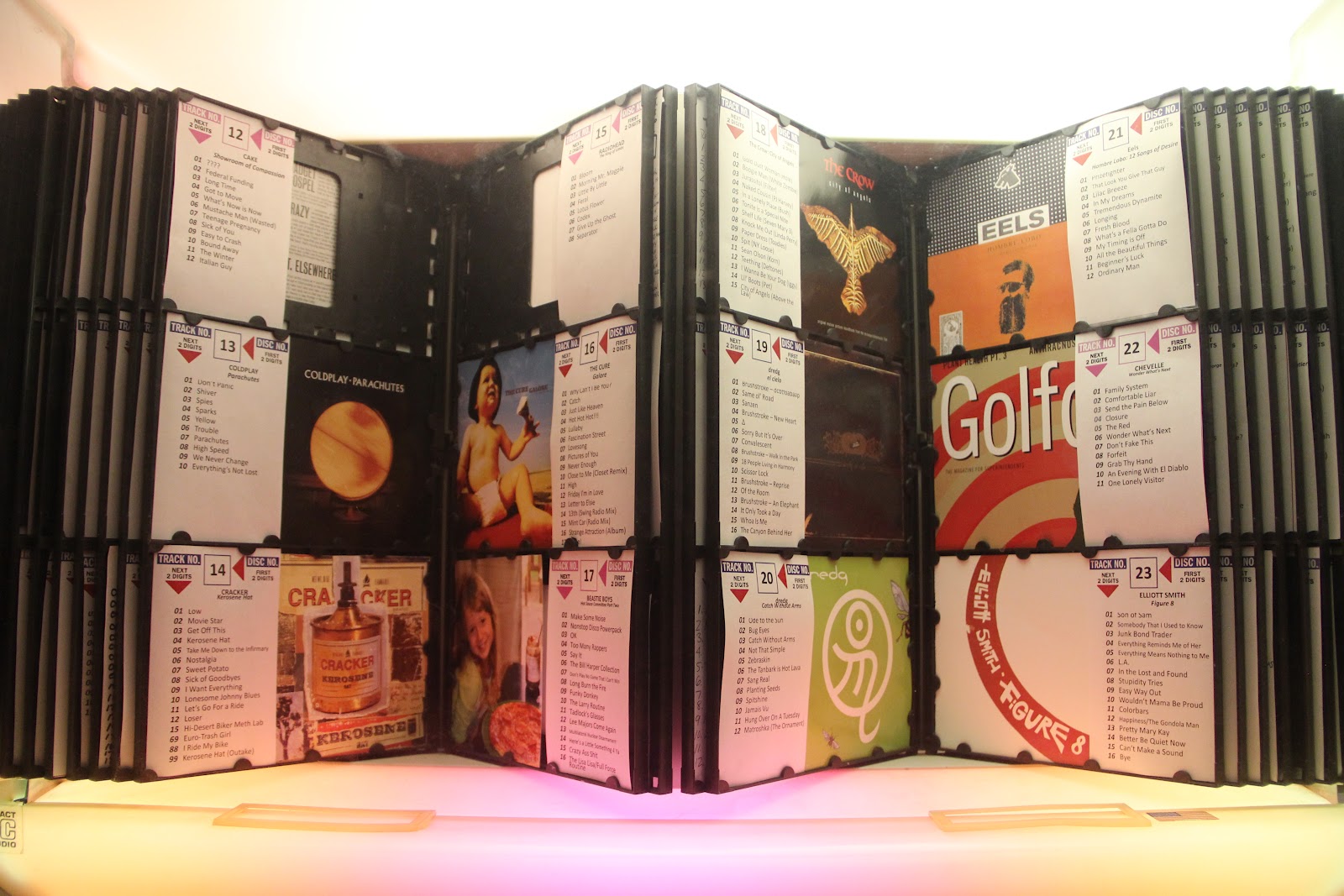
Probably the only juke in the world with two Dredg CDs. Note the Golfdom cover used for Chevelle art, and Evey for Beastie Boys. Also, Cracker, Eels, Crow 2, Cure, Elliott Smith.
Flys, Everclear first and second album, Gnarls, George Strait (only country CD in the juke, for Adro), Harvey Danger, Foo Fighters (2X) Interpol, INXS, Jack Johnson, Incubus.
Jay-Z, Jon Spencer Blues Explosion, BBoys, Beck, Counting Crows, 8Stops7, Killers, Harvey Danger, Local H (X3), Marcy Playground. Used Mexican luchadore for Harvey art.

Marcy Playground (X2), Machester Orchestra, King's X, QOTSA, Seether, Pearl Jam (X6)

Saul Williams, People in Planes, Pixies, Poe, Muse, QOTSA (X2), Q-Tip, Radiohead (X4). 100% album art on this page, which is kind of hard to do.

Rage, Michael Jackson No. 1s, Li'l Kim, Ludacris, Sheila Divine, Sublime, Soundgarden (X2), Soul Coughing, Spider-Man 3 sndtrk, Silverman, Slipknot. Note I used artwork from my "What Would Jacko Do?" comic for the Jackson CD.

Star Sailor, Staind, Jimi, Thom Yorke, Marilyn Manson, Toadies, White Stripes (X2) Ting Tings, Tool, Weezer, Zombie

Early Depeche Mode, Vampire Weekend, Yeah Yeah Yeahs, War's greatest hits. 

Some fast facts of the juke, courtesy of the juke's auditing system (asterisks denotes an Evey favorite):

Ten Most popular songs in the jukebox: 
143 plays* -- Ting Tings, "Great DJ"
85 plays* -- Billy Joel, "Tell Her About It"
76 plays* -- Vampire Weekend, "Cousins"
60 plays* -- Ting Tings, "Not My Name"
51 plays* -- War, "Spill the Wine"
39 plays -- Manchester Orchestra, "I've Got Friends"
38 plays -- Manchester Orchestra, "Shake it Out"
34 plays -- Radiohead, "House of Cards"
30 plays -- Toadies, "Tyler"
29 plays -- Queens of the Stone Age, "Make it Wit Chu"
29 plays -- Radiohead, "All I Need"

LEAST popular CDs in the jukebox
52 plays -- Jay-Z, The Black Album
60 plays -- Ludacris, Word of Mouf
62 plays -- Slipknot, The Subliminal Verses
62 plays -- Li'l Kim, La Bella Mafia
67 plays -- Q-Tip, Amplified
98 plays -- Yeah Yeah Yeahs, Fever to Tell

MOST popular CDs in the jukebox
393 plays -- Radiohead, In Rainbows
357 plays -- Radiohead, OK Computer
338 plays -- Beck, Odelay
327 plays -- Beastie Boys, Check Your Head
301 plays* -- Billy Joel, Greatest Hits Disc 2
301 plays -- Soundgarden, Superunknown
300 plays -- Manchester Orchestra, Mean Everything to Nothing

There you have it. I'll tear down all the art/playlists soon, and start reassembling the juke with the new art/playlists. It'll be a process. I am looking forward to having the juke back up to date, though, so I know what the hell I'm playing. Right now, I only know what CDs are in what slot -- no playlists yet.

I timed it once, and it takes about 20 minutes total to replace one CD... you have to put the CD in the correct spot in the magazine... then insert the proper album art... then create the playlist... then cut out the playlist and insert it in the right spot, with the right CD art. Then you have to inform the jukebox it has a new CD in it (by putting the machine in the service mode, then hitting 3, 1, then the CD #) I should also thank Copy Jesus at this time, who created the template for my jukebox cards for me... and he also helped me pick up the juke... in his honor, I vowed to never allow a single Pink Floyd CD in the juke.

And, if you're still reading -- which I'm sure you're not (but I had fun!) -- I would like to again thank my wife for letting me keep a giant jukebox in the basement.

I'm weird, I know. But I sure do enjoy having the juke.

Thursday, July 19, 2012

Comicon 2012


CCI 2012 was another great show. So good to see Marlan and Carla there. We had the time of our lives at the Aquabats concert, sitting in the VIP section, drinking for free all night... wow. Man, that was a wild one. That's the way to close down a con right there, my friends.

Other highlights: meeting Sergio Aragones, a nicer yacht, getting sneaky drunk on margaritas, cigars on the top deck of the yacht, the Aquabats press panel, being able to shop the convention this year.

More later (maybe) on CCI. But, yeah... that was a good time. If I never ever go again, if real life gets in the way... Saturday night was a damn fine send-off!

-Seth

Wednesday, May 9, 2012

Waydown #12.05.09

Well, I’ve often said that if I do something a second time then I’m probably in for the long haul.  And here’s my second blog-zine.  I’ll probably keep going with it.  I haven’t gotten any response at all, no idea if anyone even glanced at the first zine, but I’m doing this for me in the first place and I like posting stuff that’s potentially accessible to anyone.  I haven’t publicized this but once I start getting the word out then maybe these zines and this blog will get some traffic.  Maybe it’ll get some people to write and post their own stuff.  In whatever case, I have this compulsion to write and I think I can get it out to more readers if I post it here than on my own blog or whatever.  I started my own zine because I liked the sense of community and there’s no reason not to continue that here.  Even if that community hasn’t shown up.

I got a Kindle for my birthday.  Carla got a basic one for Christmas and she really liked it.  I’d never really thought about it -- there are always new technologies and I don’t bother with bothering with them until it seems that they would be a really great, positive change.  Besides, I already have lots of printed books that I have to read and I didn’t imagine getting a huge charge out of reading a book off of a computer screen, even one that is more convenient than a standard computer, for its own sake.  At the same time, everyone around me seemed to be getting gadgets for Christmas and I kinda wanted something like that.  Not that I need more junk, but some of that stuff seemed like it might be fun.  I didn’t think anything more of it, and Carla read one book on her Kindle, which I checked out but that was it.  Then, a few weeks after Christmas, she got me a Kindle Fire.  I was a bit taken aback -- it was a great gift but how could I fit that into my book-reading life (which is a significant part of me)?  Would I have to replace all the books I was planning to read or get new ones just to read them on this thing?  Carla had enjoyed her Kindle but she had said a few times that a more deluxe one would be so much better.  The Fire is in color and it’s touch-screen, more like a tablet computer.  Unfortunately, it’s not actually a tablet computer or else I would get a lot more use out of it.  I still use my phone for reading and such.  I haven’t really paid much attention to the iPad, mostly because I know there’s not much chance that I’ll get one, especially when I already have a laptop that works great and since they’re so expensive in the first place.  But I could see how one would be pretty great.  The Fire also operates like a Droid, which is a huge plus to me, since I try to avoid Apple products and since I just like Droids in the first place.  My phone is a Droid, so there’s some relation there but also some competition.  I admit that reading on the Fire is easier than on my phone, though I haven’t minded reading on my phone, especially considering the convenience of doing such.  Checking my e-mail on the Fire doesn’t really work since it doesn’t sync right and of course I have to have a wi-fi connection to use it for anything online, which is fine in our home but makes it a challenge to travel with (especially when you have to jump through so many hoops to use wi-fi in most public places).  I can play Words With Friends on it just fine, though.  But I have yet to download a book to it.  I still have those printed books to read (as well as audiobooks (see below)) and I just haven’t thought of a book I want enough that I feel the need to download and read it on the thing.  The biggest hurdle, though, is the fact that I’ve gotten almost all of the books on my bookshelf as gifts or very cheap or used or through books clubs -- I’ve never paid a lot for books, one of the things that makes them such attractive elements to me; downloading a book now seems to mean paying a lot more than I’m used to, usually not full price (since it’s Amazon, after all) but still.  It may be the case that I get new books on the Fire, though, so maybe I can justify the cost with the fact that I spend a goodly amount of time with a book (since I read slowly) that I get a pretty good ratio of time-to-cost value out of it.  But right now I’m mostly using it to read online articles I’ve gotten elsewhere.  And Carla uses it a lot, mostly as an easy computer substitute at home, so she can check her e-mail, Facebook, and Pinterest and look up recipes.  For her it’s perfect.  But she’s still reading books on her basic one.  I’d be even more inclined to read a book on the basic rather than the Fire -- it’s considerably lighter, thinner, and since the books are black & white originally, the lack of color doesn’t matter.  It’s possible we could end up trading.  Or that I’ll get a full tablet computer before too long (likely when my laptop gives up) though that might mean that Carla would more or less officially get the Kindle Fire... which might have been her plan all along.


In the above paragraph I did not explicitly admit that I am playing Words With Friends again. Even the part where I actually did.


REVIEWS

Amazing Spider-Man #676 (Marvel).  I still go to the comics store every week, not always on Wednesdays but at least one point during the week so I can page through the new comics.  Rarely do I buy anything, though, it’s just to catch up with what’s going on in a broad way, mostly looking at the last page of the issue to see what happens.  (Once again: if a story needs the reveal on the last page for it to be a worthwhile story then it's probably not worthwhile.)  I usually go to House of Secrets but when I’m working I don’t often have time so I’ll hit a different store, usually Hi De Ho in Santa Monica, but that’s not my usual store so I'd feel like a heel to go in there and paw through their comics and not put down a purchase for the privilege.  But why do I do that there and not at House of Secrets?  So I started getting myself into the habit of buying at least one comic each week, and when I was working at a place that had no Internet access a few months ago, I’d have a new comic to bring back and read during render times.  The only problem was that I didn’t want to start or jump into a multi-part series, which most comics are these days.  I understand why comics continue from and to each other, and I love a series as much as any other fan, but just for picking up one comic, it was frustrating.  I’d be hard-pressed to find a whole lot of series that consistently have done-in-one stories.  I think the books for younger readers, like the Marvel Adventures line, do that, but I wanted something from the full-fledged line.  And a lot of indie comics do single stories as well but I’m not going to experiment with a new series -- I just want a decent comic on the table in front of me that I can read and enjoy and have everything I need in the story in one sitting.  And yeah, a superhero story because that’s what’s fun in my casual reading.  Warren Ellis’s run on Secret Avengers was a good book to pick up for this, as those were all single stories, and by fairly big-name artists as well, but there were only so many of those, and the shop sold out of most of the issues.  So I’d ask Paul, the House’s owner as well as a loyal, knowledgeable comics reader and a good friend of mine, what comic he would recommend; the shop also had its own display of picks of the week by each of the employees.  He recommended this issue of Amazing Spider-Man, which features a battle between villain teams, one led by Doc Ock, the other by M.O.D.O.K.  It’s played mostly for laughs and it doesn’t seem firmly mired in continuity since I at least knew enough of what was going on so I could read it, though the events therein lead to an event coming up in the series, apparently.  For one issue it was great.  Spider-Man isn’t even in it.  It’s the kind of comic that Marvel used to do more often, a one-off between bigger stories before and after, something a bit off-beat that doesn’t fit anywhere else because it doesn’t have to.  Now everything, especially Marvel’s flagship title, has to be collected later on and it doesn’t leave much room for stories like this that can fall between the cracks.  But every once in a while one can come out, apparently.  And it was a fun read in one sitting during a break, and I passed it on to my nephew -- what else would I do with it?  This one-comic-a-week thing could lead to casual collecting -- which really wouldn’t even be collecting at all -- at the same time as it’s casual reading.  Though I actually stopped this program when I started watching my money more closely and when I knew that I’d have to dig through the new stuff to find just one issue, then not needing a comic to read at work since I quit that job and I could just read my other comics, especially ones I’d already paid for, at home, when I wasn’t working.  Now at the current job I have Internet access so no need for printed material.  Though it’s a shame that I’m not buying comics -- I get 40% off at the House of Secrets, at a time when I’ve come to realize that I have boxes of comics that I’ve bought that I may never get around to reading.  But maybe one or two issues here and there doesn’t hurt.


Spook Country by William Gibson (audiobook).  In the past I never had the least bit of interest in audiobooks.  Of course I love to read but why would I want to listen to a book when I could read it, like I’ve always done?  And why would I want to listen to something else when I'm listening to music (as I do all day, every day)?  It just never appealed to me.  I’ve sent off some of my dad’s audiobooks on Paperbackswap.com (mostly James Patterson books -- ug) and I even got the one adapted from the book by the Beatles’ engineers but sent it back, since I thought I was getting the printed book but somehow got the audiobook.  Around mid-March, I was lined up to do some mind-numbingly dull work at my job (even more mind-numbing than usual) and there was just no stimulation whatsoever.  (This was on the Tupac hologram job, in which there was a ton of work to do, it was just all really easy and dull.)  A co-worker friend was listening to the Game of Thrones books and something about the idea just appealed to me that day.  eMusic also offers audiobooks and I thought that I might one day eventually listen to one, just to try it out, though I didn’t think that day would be any time soon.  But I gave it a shot.  And it was pretty amazing.  Not that the book was any good (see below) but I really enjoyed the experience of the audiobook.  I went on eMusic and signed up for their most basic plan, something like one credit every three months, with each credit costing about $10 and most books being one credit.  They don’t have everything but they do have a pretty good selection, including the Hunger Games books (currently their top-sellers) and the Stephen King library -- more than enough books that a person could ever get around to, at least.  I was a bit rushed for time before work and couldn’t find a lot that appealed to me on the site without some digging (I might have gotten the Tina Fey book but Carla has it on her Kindle and I may or may not read it there) so I went with the Gibson book.  I already have the book, in print, probably a gift, and one that I could have seen putting off reading indefinitely.  But if I was planning on reading it (eventually) anyway, I might as well listen to it so I can get rid of the book and put something else on the bookshelf in its place.  It downloaded in about ten minutes, I dropped it onto the iPod, and I was set.  I listened to it at work, about an hour a day, totalling nine hours (originally nine CDs), kinda pacing myself and not wanting to concentrate on that to the exclusion of the music I wanted to get through (especially with Coachella coming up).  I got into the book a lot more than I thought I would (and more than it deserved).  I always enjoyed the times in elementary school when the teacher would read a book to us (and I could draw while listening) and I suppose there’s a part of me that has always missed that.  Listening to an audiobook works when I’m not distracted by something else -- if I’m not doing mind-numbing work or if I’m doing anything that requires the least bit of focus then I lose the listening part; with music I can get into a rhythm with it, which works when multi-tasking most activities, I can even miss parts of a song but still get it overall, but I have to be selective when I listen to an audiobook.  I might even have more retention with an audiobook, since I can just imagine what’s going on without having other visual stimulation, as well as the fact that I’m not going back and re-read what I’ve already gone over (my weakness as a reader) and not reading so closely that I catch grammar and spelling errors (another thing that makes me a slow reader).  So I got the book done in less than two weeks, a lot faster than it would have taken if I’d read it in print.  I then got On Writing by Stephen King from eMusic (going outside the plan but I didn’t have another option right away), another Gibson book, from Paperbackswap, and, again from eMusic, the Keith Richards autobiography but that's 23 hours long so it's going to take a while, even listening to it.  I even ordered that Beatles engineer audiobook again from Paperbackswap but I just got an e-mail that says it was lost in the mail.  Oh well.  I’ve signed up for a bunch of other audiobooks to get, mostly stuff that’s collecting dust on my shelf, even though that’s the stuff I really want to read, but I’m probably good with one at a time.  The first book I wanted to get has also been the most elusive: I’ve been on Snow Crash for almost a year now and I’m about halfway through it.  It’s brilliant and I’m enjoying it, though it’s so dense that it’s just a slog most days.  I think I could get my head around it a lot better if I could listen to it.  I tried to get it on a torrent site (a whole other story.  Suffice to say that I’m not going to mess with torrents again any time soon) then found it on CD and iTunes but it’s $30 either way.  I’m going to continue to try to find a more manageable version (especially since I can’t give time to reading it right now).  I can’t imagine that I’ll listen to a lot while I’m not working but it’s interesting that I can go through so many books when I’m at my busiest with work and everything else in my life.

The book itself is much like the rest of Gibson’s work post-Mona Lisa Overdrive: completely motiveless characters, scenarios that go nowhere, commentary that acts a lot more important than it really is.  The difference between this book and Gibson’s much more notable work in the sci-fi genre is that this one is set in modern times.  There’s not much difference beyond that except that he uses locations in the real world rather than ones he fabricated, which is actually a big strike against it, since the settings in his futuristic stories were often the most interesting things about them.  He’s made his New York City and Los Angeles just as dull as his characters.  They are only places for the characters to do close to nothing, except that Gibson calls out a few places just for location, never letting them add any color to the story.  Gibson also completely skips mention of any kinds of crowds in those places, some of the most populated locations in the world.  If the point of the story is to make some kind of commentary on the state of the world today, it does not go far beyond Gibson mentioning, quite pointedly, brand names and trendy technology, most of which was laughably dated probably before the book even came out.  I'm not impressed that the characters all have iPods that they use to transfer information, though Gibson writes it likes it's the most clever thing in the world that he came up with.  I've even seen it in most of the synopses about the book.  If Gibson is trying to make a point about how his work set in the modern-day and his cyberpunk stuff is actually pretty similar, it’s not a very heavy point, and it only goes to clearly show the blandness of his plotting and choice of story -- only the setting, in time, changes.  He is certainly not telling the story of these characters, since they have very little story in them, just wandering from place to place, never really getting into adventures, or at least anything that challenges them or threatens them in any way, so there is never any urgency or motivation.  There's not much that says that this is a particularly interesting time in the characters' lives.  As a matter of fact, most of their backstories reference events that seem like they were a lot more interesting than anything to happens to them here.  I don't know if Gibson is still regarded with any weight as an author, a sci-fi one or otherwise, but it's hard for me to get excited about any more of his books, which is a shame since I so loved his early work.  I'm probably only going to finish all the rest of what he's written and most likely new stuff after that then I'm done.

I’ve never listened to an audiobook before so I can’t really compare it to others, except to the ones I’ve listened to in the time since, but this one was good, as far as I could tell, as an audiobook.  I enjoyed the sound of it. The narrator, an actor I’ve never heard of, spoke clearly and enunciated calmly, never letting any kind of feeling come to, the plainness of it actually being a plus, and it was either his consistency or the editing that made it sound like he was narrating it all in one sitting.  The biggest strike against it was that he tried accents on the characters, in particular one with the main character, a female, which was a feminine voice only because he spoke more softly, then another lead character that was already annoying enough and the voice he gave him just made him irritating.  I’m not a fan of narrators giving voices or accents to characters speaking, and it seems to be the thing that annoys me the most with these things, but it’s probably a standard in an audiobook.  I’ll live.  The book is also about nine hours, nine tracks as downloaded from eMusic, and on my iPod it will pick up wherever on the track I left off.  (I don’t know if it does that with music.  It was a surprise when I went back to a track and it went to where I was.)  I got it done in under two weeks, but I was rather pacing myself, about an hour a day, since I didn’t know what book I was going to do next.  But it did the trick.  As a first audiobook it was enjoyable, if not for the story but for the experience of listening to a book, and knowing that there are other books I can ingest in this way.  Getting an actually good book to listen to would probably put me over the moon.


Top Albums of 2011:
10. Foster The People- Torches
9. The Black Keys- El Camino
8. Radiohead- King of Limbs
7. Wilco- The Whole Love
6. Washed Out- Within and Without
5. The Joy Formidable- The Big Roar
4. Yuck- Yuck
3. PJ Harvey- Let England Shake
2. Florence + the Machine- Ceremonials
1. Tune-Yards- Whokill


From an e-mail circle, if you’re not in it:  We’ve been listening to a lot of Pandora radio.  It’s so easy to just turn the TV on and there’s a radio station, with stuff you know you like, but with some choices to give it some variation.  I tried out Pandora years ago but I generally have my own stuff to listen to so I didn’t go back to it.  Now it’s on my TV and we turn it on in the evenings and just let it run. It’s kinda challenging, though: usually the station plays more of the related artists than it does the actual artists you chose.  The Pulp station plays a ton more Smiths and Morrissey, usually back-to-back, like it regards those as two separate artists, which it would play a lot of separately anyway.  (Pandora also got a lot of credit from me with the Pulp station when they played a super-rare track from a BBC session that I don’t already have.)  The Black Keys station plays a lot of White Stripes (and old blues).  The Garbage station plays a lot of Cardigans (and ‘90s).  I’ve turned on the Aretha station a few times now and have yet to hear an Aretha track (though I like the R&B, most of it recent).  The Radiohead station plays a lot of Muse, much more than for my taste (which is, like, any).  It actually plays a lot of Radiohead, but all the stations play a lot of Radiohead.  And there was a lot of Zepplin for a while (something that almost never comes up in my own personal listening) and now it seems every station wants to play the Strokes.  Also a lot of Arcade Fire and Pixies over the stations (but of course the stuff I pick usually comes from or to those.)  Though now, we’re starting to hear some repeats. I’m hearing more Strokes than I hear when I’m listening to their albums.  We switch between three or four stations, it might be time to add a few more.  I don’t want to skip over any music -- Muse -- since that will throw off the logarithm it has to come up with what to play.  So even if we keep hearing the same song, I stick with it.  But my biggest problem with it is that it doesn’t really get to why I use it in the first place: it doesn’t play a lot of new music.  I like finding new bands that have some relation to bands I like (I’ve discovered a ton of great bands just from learning that they sound like the Pixies (yeah, I know that includes a lot of bands)) so you would think that Pandora would be great for that but instead it plays a lot of the stuff I already have and know.  Yeah, I should be more adventurous in the bands I pick stations for but I also don’t want to get too out-there and have no idea what I’m listening to.  The Girls station that Carla set up has been great, as it plays a lot of garage band-type stuff, a lot of it pretty obscure (as well as a lot of obscure Girls stuff, especially from EPs).  I’m not a huge fan of the band but I like what Pandora says they’re connected to.  I tried to set up a Coachella station but apparently you can’t pick multiple bands to plug into one station.  So I’ll keep up with it, as it really is pretty wondrous, especially for free.  I’d recommend it to any fan of music, casual or hardcore.


RAVES

String cheese.  People are surprised that I never had string cheese when I was growing up.  We just never snacked on cheese, and I’m not sure I even liked to eat cheese straight in the first place.  Now Carla is planning a lot of what we eat, and I'm cool with cheese in that plan, and she got string cheese snacks in bulk from Costco.  And it's good.  It’s not real filling but I’m just used to eating a lot of carbs to get through the day, which probably isn’t a great idea.  I've liked eating cheese outside of a meal.  And Carla told me I eat it the wrong way: apparently I’m supposed to peel it but I just bite into it, like a Slim Jim.  That would probably surprise people too.


HTML is irritating to a great degree.  I don't know why anyone tolerates it.  The Opera browser is also purposely difficult but it's a necessary evil to do this.  I hate having to accept a necessary evil.

It was while I was writing this that Adam Yauch of the Beastie Boys passed away.  I found out that Friday morning, right before we left on a trip for the weekend.  It was hard to know what to think.  I didn’t take it too well, still kinda recovering.  The Beastie Boys' music has been a cornerstone in my life for the last 25 years.  I saw them in concert three times, including Coachella.  Yauch was always kinda my favorite.  They were never as prolific as I wished they were but I always thought they'd be putting out something new every few years for as long as I'd be around, at least.  Now nothing.  Well, this will give me the chance to really get into Hot Sauce Committee.  And it will give everyone else a chance to finally get and appreciate Paul’s Boutique, though if you haven't already then I don't know how we're friends.  Anyway, rest in peace, Adam.  Be true to yourself and you will never fall.


Yeah. 

Thursday, April 5, 2012

Waydown #12.04.05

Zine withdrawls? Maybe. I don't mind having the time I would put into making a zine back, but the camaraderie we had once exchanging zines isn't there -- heck, we haven't even had a lot of e-mail circles of late. Yeah, everyone's moved on, everyone's busy, I get that -- I am too. But I still want to contribute something, to somewhere, and I'd like to keep it amongst the Pulp Legacy group, whether y'all are going to participate or not. But I hope you will. These reviews of comics and books and cereal and Raves and pictures of half-naked girls* have to go somewhere. So I plan to post on this blog, much of the usual stuff I would put in my zines but in a capsulated form, abbreviated (in the length of the zine, not in the length of the blocks of text) but maybe more frequent. Just the best, most interesting parts. Probably not a lot of updates about what's going on in my life, unless it has to do directly with something I want to talk about (and I'll probably send those updates to you over e-mail directly anyway, just to check in on a personal level). And I've even decided that I'll post mailing comments for the last (?) issue of PL here as well (when I get around to reading the thing and writing it all up). So the usual stuff you've read by me (if you've bothered to read it), just here on the blog. I'd rather think of it less as putting stuff here because I can't put it in a zine but rather where it would go in the natural evolution of what zines would be and how they would relate to blogs. So this could just be a natural progression of the APA and what we probably would have done anyway. This could be a better way to go in the first place. So I'm not promising when I'll get stuff up here, though a goal would be every week (like I could ever hit that deadline -- you know me). Maybe once every two weeks, or once every month. Two months, like our (supposed) usual deadline for the print zine? Maybe that would be more like it. But we'll see what happens. I'm also rearranging the numbering, just to keep it organized (if only for myself.  Yeah, it's kinda confusing, and it's a bit misleading to put a number symbol in front of it but that's the best I can come up with). And whatever else I come up with to put on here. Maybe it will be an adventure. And hopefully the rest of y'all will follow, if only just reading what I post and commenting or even coming around and posting some of your material on here. Let's see how it happens, yeah?
(*except for the half-naked girls, probably)

A hold-out from the original Waydown: I'm currently about 2,663 e-mails behind. Yeah, that's a lot more than I planned for it to ever be, and a ton more than where I thought I would be right now, especially after having some time to finally get to it. But for a while the time and energy I put into replying to (old) e-mails is being taken up by replying to Facebook messages I got on my birthday, most of which were posted on my Wall, somewhere around 100 of them. Yes, replying to each and every post. And yes, it's a lot of time and energy. But I really do appreciate every person wishing me a happy birthday and I want to show that appreciation how I can. It's a lot of time and energy but it's also a great way to catch up with a lot of folks, some of which I've been very close to at one time, that I don't talk to all that much anymore. It's also a lot of work contacts, and I could use some leads for work right now. I'm sending out a lot of updates, and updating those updates as things happen (as did while I was working then when I wasn't), so this is actually just an extension of how I communicate with a lot of people in my life, at least with those who are into e-mail. So far it's working out, and I'm getting a lot of replies back, though that only buries me more with how many e-mails behind I am. Not that I mind. I'll keep digging, no matter how many there are. I hate the thought of not hearing from my people. It keeps going on and on.

RAVE

Posting a zine online. Kinda obvious, eh? But it’s still pretty crazy how we can do it now. I write up a piece then a while later on my lunch hour at work I edit it then post it and a few minutes later it could be on the screen of your computer. The efficiency is just crazy.

I just got done with William Gibson’s Spook Country on audiobook so hopefully I’ll get a review on that next time. Not a lot of comics I’m reading lately but the few I’ve gotten through I’ll get reviews up too.

Um, if this zine-on-a-blog thing turns out to be a productive idea in the first place.

Tuesday, April 19, 2011

TV characters... where are they now?


Apparently Zach Morris, AKA "Preppy" from "Saved by the Bell," grew up to be a lawyer. He'll be on the new TNT show "Franklin and Bash." Looks like he is a real lady's man, too.

It makes sense, it's a natural progression for Preppy. I'm happy to see some continuity in my childhood fictional characters. Preppy wasn't going to grow up to be a firefighter, he was always destined to be a smooth-talking, womanizing lawyer.

How about some other characters?

Al Bundy from "Married with Children" has to be the biggest winner by marrying the amazingly hot Sofia Vergara on "Modern Family." He deserves it, I assume, for all the trouble Peg Bundy put him through. We haven't heard the backstory yet, but I'm sure Peg took Al Bundy for what little he was worth (not much money in the shoe salesman business) and Al had to rebuild himself from the ground up... and boy did he bounce (and I mean bounce) back nicely, somehow scoring the big house in Orange County with a much younger wife. Well played, Mr. Bundy.

I blame the parents, when it comes to Doogie Howser, M.D. What did they expect? When a kid misses out on his childhood -- from 6th grade to med school? -- he's going to rebel, eventually. So Doogie got out of medicine and tried to regain his teenage/early 20s by whoring himself out as Barney Stinson on "How I Met Your Mother." I'm sure Doogie-Barney will eventually find the proper path, but until then... well, it's a loss for modern medicine, really.


This one is less current, but I was always happy to see that after Bo Duke got done outrunning the law and moonshining with his brother Luke on "Dukes of Hazzard," he went on to marry a nice Kansas girl. Then one day they discovered a baby on their farm, apparently shot to earth on some crude spaceship, perhaps from a dying planet? That baby would become Clark Kent, Bo would become Jonathon Kent, and they would all live happily ever after on "Smallville."

This one is the most tragic... how did the lovable, cat-eating alien Alf go from friend to foe? Where did the relationship break down? In another TNT series, Alf returns as the star in "Falling Skies." And this time, he's not here on earth just for the pussy.